Bound propagation already computes an LP relaxation of every box. Its dual is closed form, so a valid bound needs no LP solve.
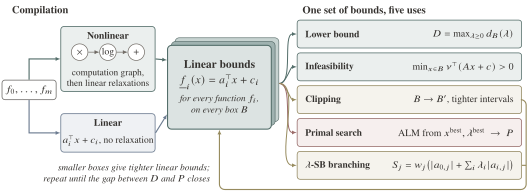
GEAR builds a global solver for bounded nonlinear programs on that observation. All boxes form one tensor of linear bounds, and the same tensor gives the lower bound, tests infeasibility, clips the boxes, starts the primal search and picks where to branch. A run returns a feasible point and a lower bound within a relative gap of 10−4. On 505 problems from GAMS and MINLPLib, GEAR certifies 421 within 180 s, more than each of six global solvers, including Gurobi.
How GEAR works
A neural network verifier bounds the outputs of a computation graph over a box of inputs. Linear bound propagation does this with a linear lower and upper bound for every output, and it runs on GPUs for thousands of boxes at once. A nonlinear program over a box is a computation graph too: its objective and constraints are the outputs.
Verification alone is not a solver. Its bound minimizes over the whole box, so a box keeps a low bound that comes from infeasible points however far it is split, and it keeps no feasible point to prune against. The step that changes this is to read the linear bounds of the constraints as what they are.
The linear bounds are already an LP
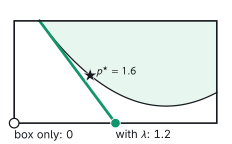
On one box, each constraint has a linear lower bound, so every feasible point satisfies Ax + c ≤ 0. With the objective’s linear bound, that is an LP relaxation of the box, on every box, from one propagation over all outputs.
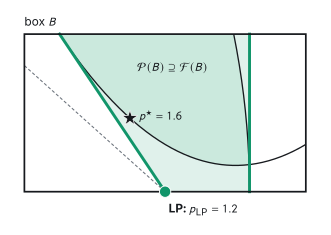
Its dual is closed form, so a valid bound needs no LP solve
The smallest example: minimize x on [0, 1] subject to x ≥ 1/2. Without the constraint the bound stays 0 however far the box is split. Move the slider to add the constraint with a multiplier: the line flattens and its minimum over the box rises to the optimum.
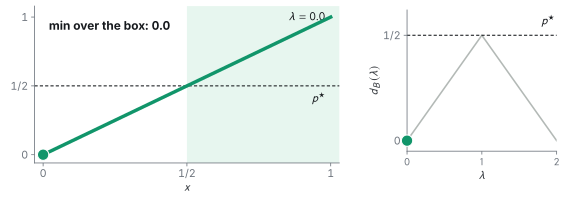
Every λ ≥ 0 gives a valid bound in closed form, at O(mn) per evaluation, with a(λ) = a0 + ATλ, and the best λ reaches the LP. LP solvers only propose multipliers. These multipliers act on the linear bounds and are distinct from the ALM multipliers of the primal search.
One tensor, five uses
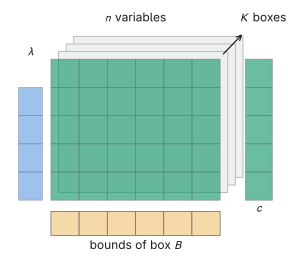
All boxes form one tensor: K boxes × (m+1) functions × n variables. Each use is a sum or a min along its axes, which is why it batches. Pick a use to see the part of the tensor it reads and what it does on one box.
Primal and dual share the bounds
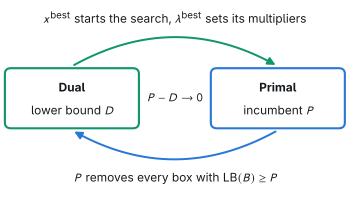
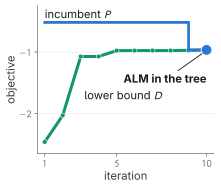
The minimizer of the bound and its multipliers start a projected augmented Lagrangian, which needs only graph evaluations, autodiff and projection, so it batches like the bounds. Its incumbent removes every box whose bound reaches it. On Modlangerman (10 variables), P stays at −0.517 for nine iterations while D rises from −2.46 to −0.972; then the search inside the tree finds −0.965 and the gap closes. P improves in the tree on 21 of 420 certified runs: most optimal points are found at the root, and the tree supplies the proof.
A real run, box by box
HS059 has two variables on [0, 75] × [0, 65], three nonlinear constraints and a nonconvex feasible set (shaded). Rectangles: the boxes still open in GEAR’s run. Move the slider to follow the run.
The price, and what the GPU gives
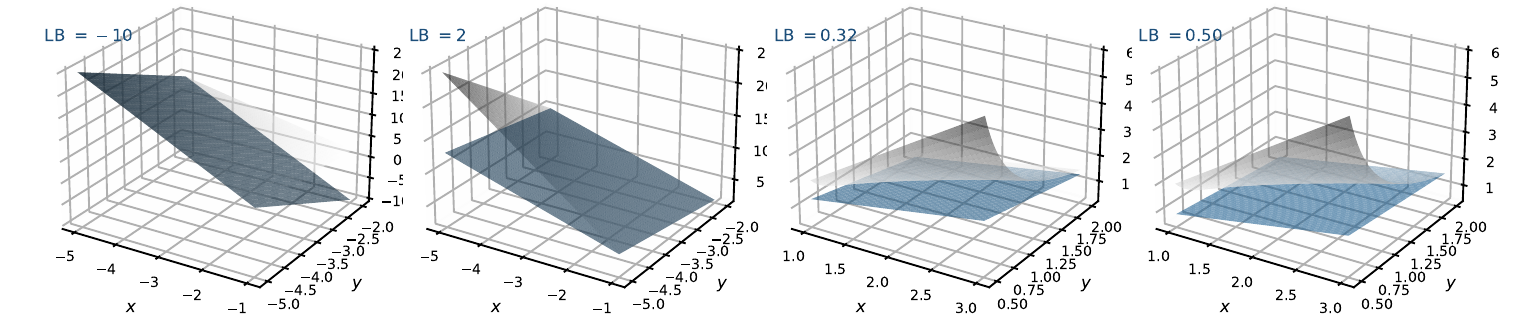
One linear bound per output is looser than an LP with all McCormick planes. Tighter operator relaxations narrow that: for a product, the best plane on the box moves the bound from −10 to 2; for a quotient, planes built for x/y directly move it from 0.32 to 0.50.
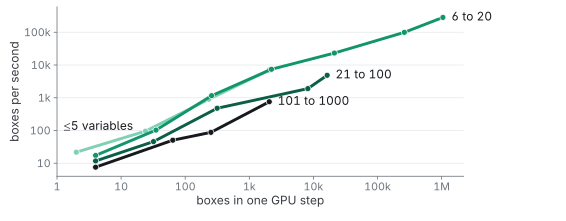
On the GPU, throughput grows with the batch: up to 1,048,576 boxes in one step, and on 6 to 20 variables from 17 boxes per second in small steps to 284,000 in the largest.
What each part of the solver adds
Components are added one group per row, up to the full solver (Table 2 of the paper). Feasible: the returned point satisfies every constraint to 10−6. Optimal: that point is also within the relative gap of the best known value, with or without a dual certificate. Solved: a certified lower bound closes the gap.
The bottleneck is the proof, not the point.
With the ALM search, GEAR already holds an optimal point on 471 instances. The later rows raise solved from 269 to 421 and add only 7 optimal points.
Dual bounds turn points into proofs.
Dual bounds with clipping add 97 solved instances and one optimal point, the largest step after presolve and the CPU components.
The first row is the usual setting of neural network verifiers.
421 of 505 certified in 180 seconds
505 bounded continuous nonlinear programs (265 from gams_world, 240 from MINLPLib) against six global and six local solvers
through AMPL, all on one workstation (AMD Ryzen 9700X, 16 threads, one RTX 5090), 180 s per instance, one configuration per solver tuned on a
40-instance subset.
Certified instances over time
Instances certified within t seconds; hover to read every solver at one time.
Who certifies what the other misses
Instances certified by GEAR but not by the solver (right), and by the solver but not by GEAR (left).
Where GEAR leads, and where it does not
Broken down by size, constraint count and kind of nonlinearity, the benchmark shows one regime where GEAR leads and one where it does not (Appendix D.1 of the paper).
Share of each problem class certified
Global union: certified by at least one of the six global solvers. Right: instances only GEAR, or only the union, certifies.
GEAR leads on composite nonlinearities in low dimension.
GEAR certifies 322 of the 330 instances with at most 20 constraints (SCIP 278, Gurobi 298) and 131 of 147 with exponential, logarithmic, square-root or trigonometric terms (SCIP 100, Gurobi 110). Relaxations of such compositions are loose. Of those 131, 75 close at the root and 56 in the GPU tree.
On large structured models, the tree decides.
Above 20 constraints GEAR certifies 99 of 175 against Gurobi’s 103; 20 of the 22 instances only the global union certifies are pooling, wastewater, water-network and circle-packing models. Their root relaxations match, the batched GPU bounds are weaker than the exact LP, and Gurobi’s tree runs at 2.9·103 to 4.0·104 nodes per second. GEAR certifies none above 1,000 variables.
The gain is coverage, not latency.
When GEAR overtakes each global solver
The time after which GEAR has certified more instances than the solver, at every later time up to 180 s.
GEAR and the six global solvers together
All 505 instances by who certifies them.
The 16 instances only GEAR certifies
Grouped by cause, read from the Gurobi and SCIP logs (Appendix D.2 of the paper). Twelve close at the root; on three, a baseline’s point fails the 10−6 re-check. All contain transcendental terms. Each opens in the gap atlas with its formulation, every solver’s gap over time, the commands and the logs.
Relative gap between the best known optimum and each solver’s certified lower bound, over time. GEAR closes it within seconds; the six global solvers end their 180 s with the gap still open.
Reproduce every number
The repository holds the 505 models, the baseline harness with every configuration it tried, the log of every run behind the tables and the scored per-instance results. The GEAR source will be released there; until then its configuration and the exact command of every run are published with its logs.
The scoring rule
A run is solved when its returned point satisfies every constraint and bound of the original model, with equalities kept exact, to absolute tolerance 10−6, and its primal value P and certified lower bound D satisfy
(P − D) / max(1, |P|, |D|) ≤ 10−4.Baseline points are re-evaluated in AMPL; GEAR replays its point on the original model before returning it. Local solvers have no D and are credited when their feasible P matches the tightest bound a global solver certified. A certificate contradicted by a better feasible point from any run is withdrawn, and an infeasibility verdict counts once two global solvers confirm it.
Get the logs and verify them
One archive per solver, one log per instance, local paths replaced; the checksums cover every archive, the GEAR configuration, its per-instance results and the manifest.
git clone https://github.com/Verified-Intelligence/GEAR.git cd GEAR (cd logs && sha256sum -c SHA256SUMS) tar -xJf logs/gear.tar.xz # gear/<family>/<instance>.logRecount Table 1 from the scored results
One row per solver and instance, with the certificate, P, D, the maximum violation and the time.
# global solvers: column 6 (criterion b); local solvers: column 10 (match with a certified bound) awk -F'\t' 'NR>1 && (($2=="global") ? $6 : $10)==1 {n[$1]++} END {for (s in n) print s, n[s]}' \ baselines/results/per_instance_long.tsv # GEAR: one row per instance, column 4 = certified awk -F'\t' 'NR>1 && $4==1 {n++} END {print "gear", n}' logs/gear_results.tsvRerun the baselines
The harness runs each solver through its AMPL driver with its chosen configuration;
baselines/commands.mdlists every option string and thread layout.pip install amplpy python -m amplpy.modules install base coin baron knitro lgo lindoglobal minos scip snopt gurobi xpress conopt python -m amplpy.modules activate <your-license-uuid> cd baselines python harness/bl.py drive --config configs/chosen/gurobi_cfg.json --run final_gurobi --time-limit 180 bash harness/run_campaign.sh # all solvers: tuning, then the final runsThe GEAR runs
One instance at a time on one RTX 5090 with 16 CPU threads, the same configuration for all 505 instances (
int3p_crownmerge.yaml). Every GEAR log starts with the command that produced it:python nlp_example.py --problem_name hs101 --benchmark gams_world --benchmark_root benchmarks \ --device cuda --override_timeout 180.0 --config configs/int3p_crownmerge.yamlThe
Configurations:block at the top of a GEAR log lists argument defaults, not the settings in effect.Inspect any instance
The gap atlas shows, for any subset of GEAR and the 12 AMPL solvers, which of them certify each instance, how each bound closes over time, the formulation, the command and the full logs.
baselines/benchmark/the 505 AMPL models and manifest.tsv(family, instance, sense, size, sha256)baselines/configs/every configuration tried in tuning, the chosen one per solver, the 40-instance subset baselines/results/scored per-instance tables, the final table and the tuning log logs/logs of the 13 final runs, gear_results.tsv, the GEAR configuration, manifest and checksumssite/this page and the gap atlas
BibTeX
@inproceedings{zhou2026gear,
  title     = {{GEAR}: A {GPU}-Accelerated Global Solver for Bounded Continuous Nonlinear Programs via Linear Bound Propagation},
  author    = {Zhou, Duo and Chen, Hesun and Zhong, Xiangru and Hanasusanto, Grani A. and Zhang, Huan},
  booktitle = {Advances in Neural Information Processing Systems (NeurIPS)},
  year      = {2026}
}